


Bloomerism
Bloomerism – an unsuccessful attempt by feminists in the mid-nineteenth century to reform traditional women’s clothing by replacing heavy women’s dresses with bloomers, bloomer, or the Bloomer costume, which consisted of a short and fairly wide skirt worn with pantaloons.
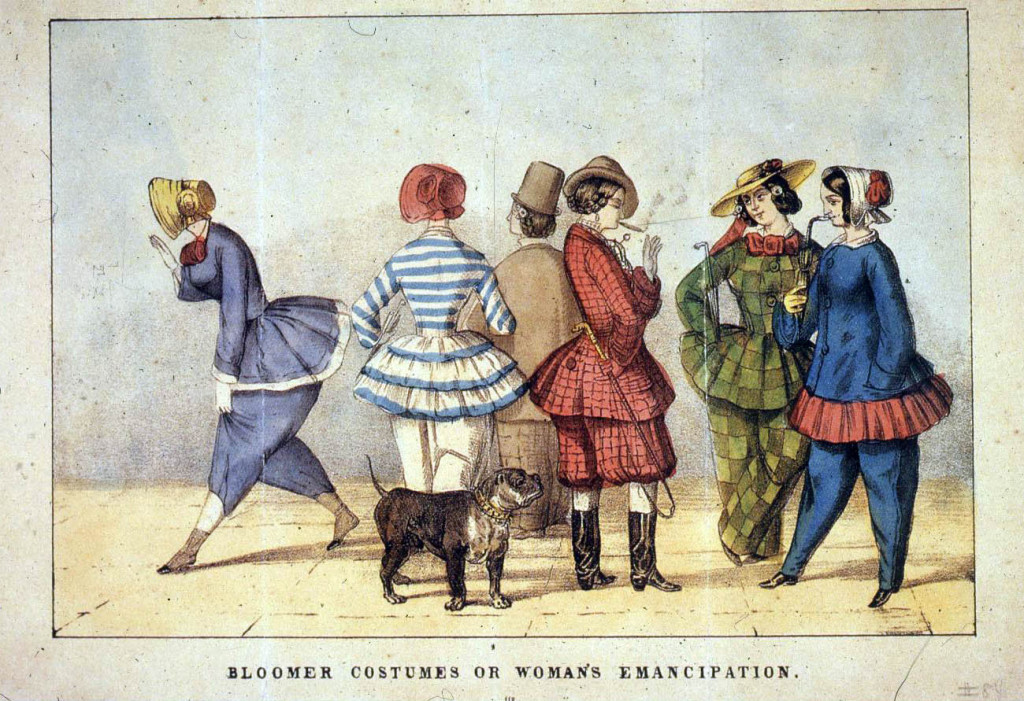
Fig. 1. Bloomer costumes, or women’s emancipation. Drawing from the early 1850s. Source: The History Project, University of California, Davis.
The term bloomerism appeared in honour of, and thanks to, the American suffragist Amelia Jenks Bloomer.
Amelia Bloomer was born in 1818 into a poor family; her childhood was spent in Cortland County, New York. At the age of twenty-two, Amelia married the lawyer Dexter Bloomer, who encouraged her to write articles for a newspaper. She began her writing activity in the New York newspaper Seneca Falls County Courier.
In 1848, Amelia took part in the Woman’s Rights Convention at Seneca Falls. In 1849, she began publishing her views in her own periodical, The Lily, which appeared every two weeks. The newspaper, whose main appeal to its readers was a call for temperance and abstinence, gradually began to cover an increasingly broad range of social issues, from sobriety and temperance to women’s rights. Its popularity unexpectedly began to grow, and soon its circulation exceeded 4,000 copies.
In her newspaper, Amelia also published articles devoted to women’s fashion. Bloomer promoted the ideas of New Harmony of the 1820s and defended the clothing worn by socialist women.
In 1853, Amelia Bloomer, who by that time had become a well-known and passionate advocate of women’s suffrage, literally shocked the public that had gathered to hear her next speech. She shocked them not by the speech itself, but by the fact that the women’s rights activist appeared before the audience in clothing considered entirely indecent at the time: pantaloons and a knee-length skirt.
Amelia herself knew what she was doing. In her understanding, the real struggle for women’s rights consisted not only, and not exclusively, in securing the right to elect the president of the country, but also in the right to wear comfortable clothing. She firmly maintained that every woman had the right to wear the clothing she liked and found comfortable, without asking men’s permission. Amelia called men overreaching dictators who had taken all power in society and at the same time dictated moral norms.
Thus, it was in honour of Amelia Bloomer that the words bloomers, bloomer, and Bloomer costume appeared in English: a short and fairly wide skirt combined with pantaloons gathered at the ankle with elastic or a cord. At the turn of the century, this became a women’s cycling costume (Chelpanova, 2010).
After the first shock, the public immediately responded to this unprecedented outfit with ridicule. The new clothing — bloomers — was openly mocked. There were, however, those who supported Amelia. It should be noted that the Bloomer costume itself was not invented by Amelia, but by women of the Oneida commune, among whom was the activist Elizabeth Smith Miller, also known as Libby Miller. It was she who showed Amelia this garment, and she herself wore this form of clothing enthusiastically for several years, contributing in every possible way to its popularization. Other well-known women who were among the first to wear bloomers included the feminists Susan B. Anthony and Elizabeth Cady Stanton (Chelpanova, 2010).
It is known, however, that reforms were introduced into everyday life very slowly and with great difficulty. In the end, Amelia’s attempt to “turn women’s fashion upside down” may be called unsuccessful: even the most active feminists eventually returned to the clothing forms familiar to them (Chelpanova, 2010).
Bloomers were called both indecent and masculinizing. At the same time, the alleged indecency of this clothing was believed by the public to encourage divorce and free love. Because of their masculine appearance and association with the cigar, trousers were also called pantalon à la masculine.
The feminist reform of clothing disrupted traditions and social foundations. In the opinion of male feminists, it had gone too far, and they tried to dissuade feminists from it, accusing them of making the common cause a laughingstock. In New York, women in freedom dress were surrounded by a crowd that mocked them, made faces, and shouted insults; the police even had to intervene. A great deal of humour and courage was needed to withstand such aggressive reactions and family resistance (Bard, 2013).
Press attention to bloomers reached its peak in 1851, and the topic overshadowed demands concerning employment and the right to vote. In 1853, under pressure from her father and friends, Elizabeth Cady Stanton gave up wearing trousers: being too conspicuous, they endangered the cause of women’s rights. For some time she wore a short dress, for which she began to be reproached for showing her legs. Lucy Stone, another well-known American suffragist and abolitionist, also gave in. Amelia Bloomer herself wore her costume for six years and also returned to dresses by the end of the 1850s. According to Susan B. Anthony, who called this experiment in dress-code reform a “mental crucifixion,” these women were looked at, but no one listened to them (Bard, 2013).
From the perspective of gender and feminist theory, bloomerism is significant because it shows that women’s emancipation was connected not only with legal and political rights, but also with bodily freedom, mobility, comfort, and control over appearance. The hostile reaction to bloomers reveals how strongly nineteenth-century gender norms regulated women’s bodies and how clothing functioned as a visible marker of femininity, modesty, respectability, and social obedience. Feminist dress reform therefore challenged not merely fashion, but the patriarchal organization of gender itself.
References:
Bard, C. (2013). Politicheskaia istoriia briuk [A political history of trousers] (S. Petrova, Trans.). Moscow: Novoe literaturnoe obozrenie. [in Russian].
Chelpanova, P. (2010). Amelia Bloomer. Znamenitosti: Internet portal. Retrieved from http://www.peoples.ru/state/statesmen/amelia_jenks_bloomer [in Russian].
Shevchenko, Z. V. (Comp.). (2016). Blumeryzm [Bloomerism]. In Slovnyk gendernykh terminiv [Dictionary of Gender Terms] (pp. 24–27). Cherkasy: Chabanenko Yu. [in Ukrainian].
Leave a Reply